You ever have those moments when you just want to climb a tree and scream as loud as you can? If so, you may be part of the family Cicadidae, the true cicadas. That makes you a cousin of about 3,000 other species. This includes the currently infamous broods XIII and XIX.
These periodical cicadas belong in the genus Magicicada spending 99% of life underground in the nymph stage. They emerge as adults every 13 years (Brood XIII) or 17 years (Brood XIX). Actually, there are four species of Brood XIII (M. tredecim, M. neotredecim, M. tredecassini, M. tredecula) and three species of Brood XIX (M. septendecim, M. cassini, M. septendecula).
These two broods stand to make history with this year’s synchronous emergence, occurring once every 221 years. This year marks the first time these two broods emerge together since 1803. To put that in perspective, Thomas Jefferson was President.
To add to the historical note, millions of cicadas will emerge. Why expect so many? It is termed predator satiation in which prey occur at extremely high population densities, reducing the probability of every individual being eaten.

The urge-to-emerge begins when the soil temperature rises above 64 °F at a depth of 8-12 inches. This occurs between late April and early June depending upon geographic location.
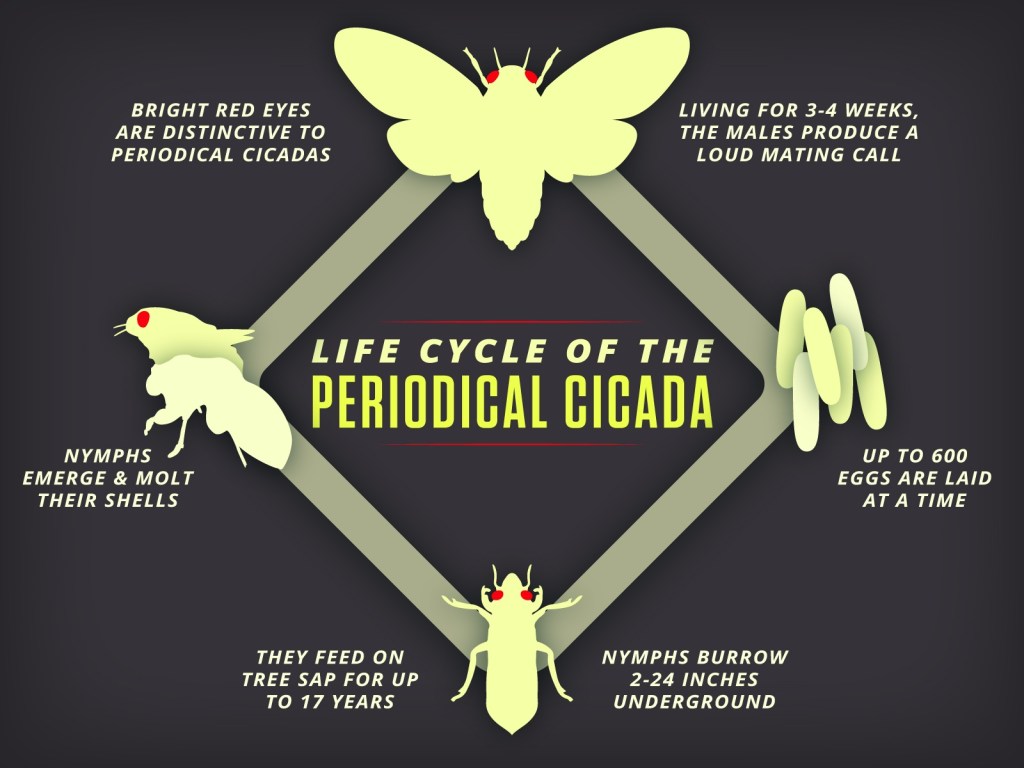
Shortly after the crepuscular emergence they shed their exoskeleton transforming into the adult stage.
Adults seek one thing … reproduction. Males are so focused on attracting a female that they do not eat. Rather, they only drink fluids to avoid dehydration. And how do the males attract the females … by climbing trees and screaming. However, screaming to our ears transfers to singing by the female cicada. Males produce three stages of the courtship song via tymbals, corrugated membranes in the abdomen. With so many males around this year, we may expect “singing” in the range of 80-100 decibels, or about the loudness of a gas-powered lawn mower. Females signal their acceptance to mate with conspecific males by timed wing-flicks. Once mated, females carve a V-shape into young twigs and deposits up to 20 eggs per clutch up to 600 clutches. After a few weeks nymphs hatch, fall to the ground, and dig in. Adults live about three weeks.

Fortunately for us in East Texas, the preponderance of the historical emergence is well outside of our boundaries. As one can see from the map, the Midwestern states will enjoy the cicadian chorus with a bit of overlap between western Louisiana and East Texas. However, that is only with Brood XIX.
To reduce the number of cicadas in your yard, you might consider harvesting them. After all, birds, snakes, and bats enjoy a scrumptious cicada. Why not try them as a low fat, high protein snack? One can roast them, put them in a pasta, or fix a cicada taco. If interested, try Cicada-Licious: Cooking and Enjoying Periodical Cicadas by Jenna Jadin and the University of Maryland Cicadamaniacs (2004). Oh, one caveat: cicadas share a family relation to shrimp and lobsters. So, if you are allergic to seafood, check with your doctor (entomologist) for advice.

Or, you might want to climb that tree with the cicadas and just scream.
Feature Image: Sakharpe, Mihika/DOGA News

 Wade Village