At about 4AM it interrupted a restful night at the farm, the singing. The three or four choralists harmonized their tribute to the night sky. I heard them before in the low mountains of New Mexico. I even spotted one alone scurrying down a path in the Big Bend. Still, the soulful melody surprised me as it carried through the piney woods of East Texas. Locals call it by several names, including Song Dog. However, the name coyote comes from the Nahuatl (Aztec) word coyotl, meaning barking dog.
Coyotes have inhabited North America since the Pleistocene Epoch, that ended 11,700 years ago. I knew that coyotes roamed throughout the region, but never considered our farm as a likely habitat. Thinking about it, that is a silly notion as one finds Canis latrans all over North America. That includes major cities like Los Angles, Phoenix, Dallas, Chicago, and New York City. The subspecies found in East Texas is C. latrans frustror.
Some locals call them Prairie Wolf, however, a coyote is not a wolf. The last two wolves were killed in the Trans-Pecos region in 1970 leaving no trace throughout Texas. Coyotes displaced their red wolf cousins found in East Texas years ago. We find the American Red Wolves only in North Carolina as federally protected under the Endangered Species Act.
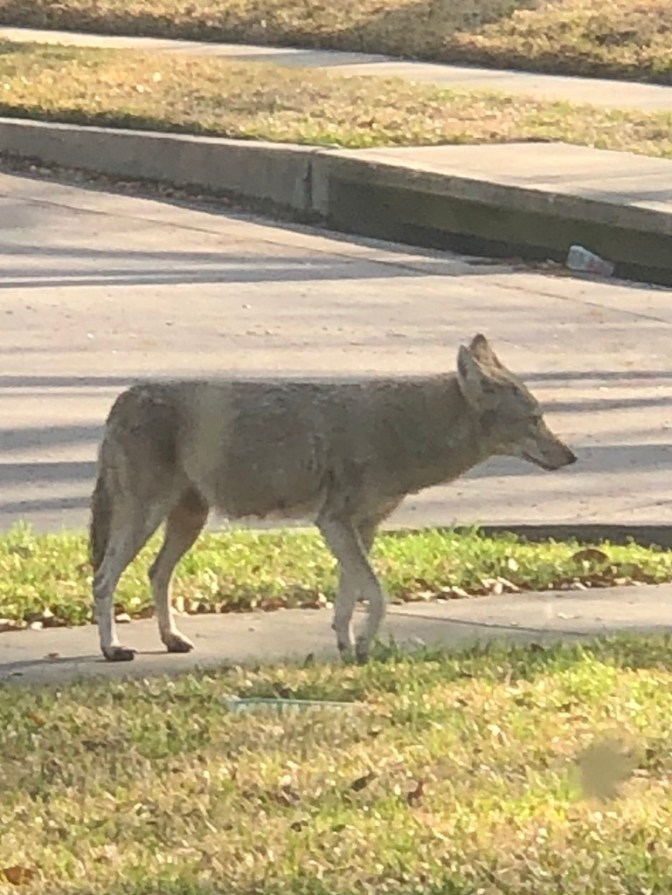
Coyotes differ from wolves in appearance, size, and behavior. The average coyote stands 2 feet tall at the shoulder, measures 3.5 feet long including the tail, and weighs about 30 pounds. Their color is generally gray with some light shades of black and tan. Their pointed ears sit atop a narrow head with a pointed muzzle. They vocalize through yips, barks, and a short high-pitched howl.
Following a Fission-Fusion social structure coyotes gather into a pack (fusion) at night, then disperse (fission) into small groups, but usually alone, during the day. Crepuscular by nature they may be found at anytime on the hunt. Not picky eaters coyotes dine on anything from cattle to rats to lizards to songbirds to persimmons, but not people, well, usually. Predatory attacks on people do happen. One study of coyote attacks in North America between 1960 and 2006 reports 142 attacks (62 considered predatory) on 159 victims. Those 10 years old or younger counted for 52 of those. Most attacks (70%) happened on or near the victims home, while fewer (25%) occurred in parks. The study showed no significant seasonal variations of attacks.
Generally, coyotes are wary of people. So, what does one do should one encounter a coyote? First, the obvious is do not approach (duh). Slowly back away and find another path. Secondly, do not turn and run (that makes you a victim). Making yourself as big and as loud as you can seems to work as well as throwing something at him.
If you live someplace that experiences coyote sightings, you can take precautions. You may never consider feeding a wild coyote directly. However, you may be feeding it indirectly by leaving pet food or unprotected garbage out over night. That bird feeder may entice a hungry coyote, not for the seeds, but for the squirrels, opossums, and rats that feed off the droppings.
Small pets and children should always be supervised when outside as they are vulnerable. If the yard is fenced, you may feel safe. Still, a coyote can jump and even crawl over a fence. Remember, coyotes are in search of their next meal, the easier to get the better.
Just seeing a coyote around your neighborhood is no cause for alarm. We can coexist given the proper education and following common sense precautions. Although, should you encounter a coyote exhibiting aggressive behavior, report that to the local animal control or law enforcement authority.
Sources


