OK. So during winter many species by wing or hoof travel south to warmer climes, but what if you do not want to go? Well, there is an app for that. Many engage in brumation, and others drift into a state of hibernation. Whatever their preferred choice of involuntary dormancy, it all amounts to the same physiological characteristics: lower body temperature, lower heart rate, and lower respiratory rate. Plus, food becomes scarce, so why not just sleep through it.
What animal comes to mind first…bears. Actually bears do not hibernate as their body temperature drops only 12 to 15 degrees. Known as super hibernators, they just engage in a long winter’s nap (dormancy) with neither food consumption nor waste excretion. However, if disturbed, a bear awakens immediately in a rather grumpy mood. So, try not to interrupt a good nap.
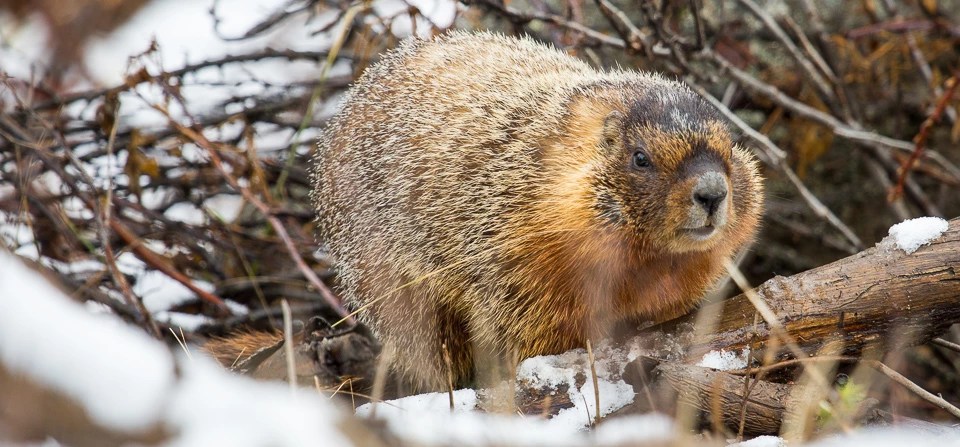
However, many animals are true hibernators. For example, the yellow-bellied marmot (Marmota Flaviventris) breathes once or twice a minute while its heart beats only five times. Unlike the bear, the marmot’s body temperature falls to around 37*F.
The list of true hibernators includes not only rodents, but bats as well. Hibernation for bats ranges from daily torpor to longer periods depending upon the species. They come out of hibernation periodically to eliminate waste and hydrate. Big brown bats (Eptesicus fuscus) metabolic rate slows to their taking one breath every two hours.
Nor do reptiles and amphibians hibernate, they enter into brumation. The difference being ectotherms, like snakes and frogs, use the environment to lower their body temperature and metabolic rate.
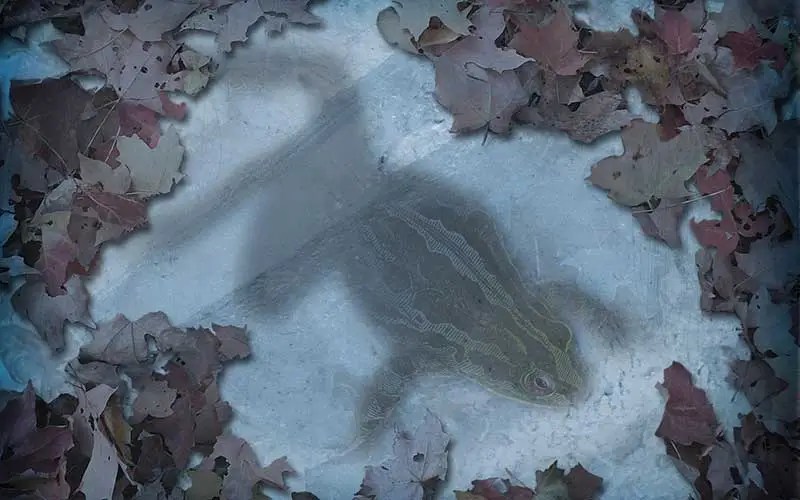
Many frogs submerge into ponds during winter where the ambient temperature does not dip below freezing. The exception is the wood frog (Rana sylvatic). This little guy buries itself in leaf litter, waits for a snow covering, and freezes 65% of its body water. During that time it produces a cryoprotectant, glycol, that serves as an anti-freeze.
As an ectotherm the common snapping turtle is incredibly cold-tolerant. When its aquatic habitat freezes over, the lower section does not. So, if the water below is 33*F, the turtle’s body temperature matches that. It “breathes” by transferring oxygen from water as it passes over blood vessels in the mouth and throat, aka extrapulmonary respiration.
However, the more efficient method is butt breathing, aka cloacal respiration. Actually, it is not in a sense breathing as much as the transference of oxygen in and carbon dioxide out through the blood vessels of the cloaca.
So, different species have different modes to get through these cold days of winter. As for me, it is a good book in front of the fireplace and, perhaps, a bit of dormancy. How about you?
Resources
Brokaw, Alson. (2025). Torpor: How Bats Chill.
Manning, Elizabeth. (2007) The Long Sleep: Which Animals Hibernate? National Park Service. Wildlife in Winter: Survival Strategies.

 Wade Village
I think I’ll tell my husband to st
LikeLike